Understanding Anal Warts and HPV
Anal warts, clinically known as condyloma acuminata, are a common anorectal condition caused by the Human Papillomavirus (HPV). Because they occur in a sensitive area, many patients feel embarrassed or hesitant to seek medical help. However, ignoring the symptoms can lead to the warts multiplying and spreading.
At Dr. Tugan Tezcaner’s clinic, located at Al Tadawi Hospital in Dubai, we provide a strictly confidential, stigma-free environment where you can receive expert diagnosis and personalized care for all anorectal conditions.
According to the [World Health Organization (WHO)](https://www.who.int/news-room/fact-sheets/detail/human-papillomavirus-(hpv )-and-cervical-cancer), HPV is one of the most common viral infections globally. While sexual contact is the primary mode of transmission, the virus can spread through simple skin-to-skin contact in the anogenital region.
There are over 100 strains of HPV. The strains that cause anal warts (most commonly types 6 and 11) are considered “low-risk” for cancer. However, patients can be co-infected with “high-risk” strains (such as types 16 and 18), which are strongly linked to anal dysplasia and cancer.
Clinical Presentation: What Do Anal Warts Look Like?
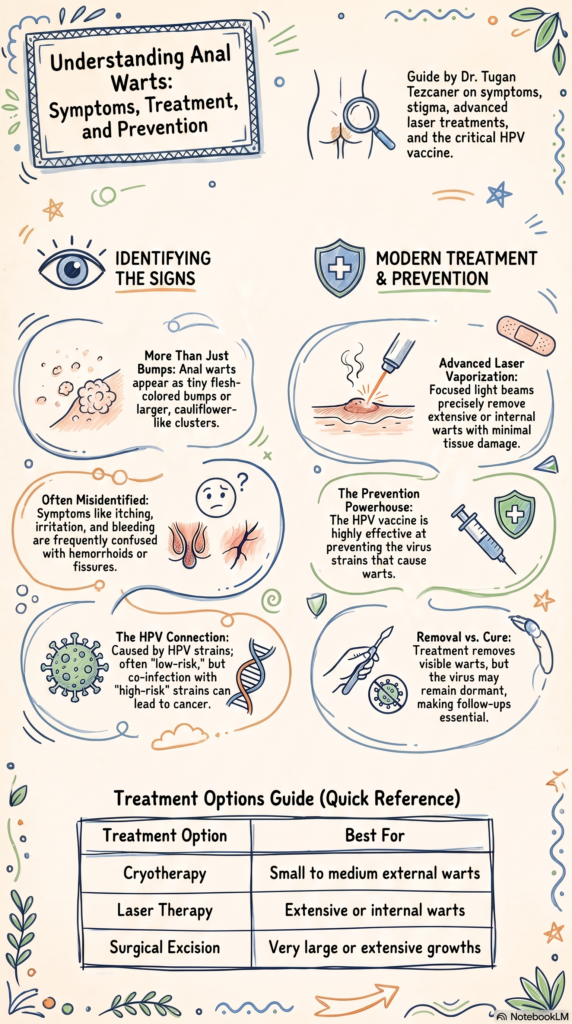
The presentation of anal warts varies significantly. Some patients may have warts so small they go unnoticed, while others develop prominent growths.
Common signs and symptoms include:
•Small Bumps: Tiny, flesh-colored, pink, or light brown bumps in and around the anal area.
•Cauliflower-like Growths: As warts multiply, they can cluster together, taking on a cauliflower-like appearance.
•Itching and Discomfort: The affected area may feel itchy, irritated, or constantly moist.
•Bleeding: Mild bleeding may occur, particularly during or after a bowel movement.
“Many patients confuse the symptoms of anal warts with other conditions like hemorrhoids or anal fissures. A professional evaluation by a proctologist is essential for an accurate diagnosis and effective treatment plan.” — Dr. Tugan Tezcaner
If you are experiencing anal pain or bleeding, it is important to understand the differences between various conditions. You can read our detailed guide on Anal Fissure vs. Hemorrhoids: How to Tell the Difference to learn more.
Risks of Untreated Anal Warts
Delaying treatment for anal warts can lead to several complications. The most immediate risk is the physical spread of the warts, making future treatment more complex. Furthermore, because anal warts are caused by HPV, there is an underlying risk associated with the virus itself. Regular monitoring through a rectosigmoidoscopy is critical to detect any internal lesions and prevent long-term complications.
Comprehensive Treatment Options in Dubai
The treatment of anal warts is highly individualized. The goal is to remove the visible warts and relieve symptoms, though it is important to note that removing the warts does not cure the underlying HPV infection. The virus may remain dormant, meaning recurrences are possible.
For a comprehensive overview of our approach, visit our dedicated Anal Warts Diagnosis and Treatment page.
Depending on the size, location, and number of warts, treatment options include:
| Treatment Option | Description | Best For |
| Topical Medications | Prescription creams applied directly to the warts to stimulate the immune system or destroy wart tissue. | Small, external warts |
| Cryotherapy | Freezing the warts with liquid nitrogen. | Small to medium external warts |
| Laser Therapy | Utilizing a focused beam of light to vaporize the warts with precision, minimizing damage to surrounding tissue. | Extensive or internal warts |
| Surgical Excision | Surgical removal of the warts under local or general anesthesia. | Very large or extensive warts |
Dr. Tugan Tezcaner utilizes advanced laser technology and ultrasonic dissectors to offer safe, precise, and minimally invasive treatment options, ensuring the fastest possible recovery for his patients.
The Critical Role of Prevention and the HPV Vaccine
While treatments are effective at managing the physical symptoms, prevention remains the most powerful tool.
The Centers for Disease Control and Prevention (CDC) strongly recommends the HPV vaccine as a highly effective method for preventing infection from the most common strains of the virus, including those that cause warts and those linked to cancer .
Who should get it?
The vaccine is most effective when administered before an individual becomes sexually active. However, it is also recommended for adults. Discussing the vaccine with your healthcare provider is a crucial step in your preventive health strategy.
Why is it important?
By preventing HPV infection, the vaccine significantly reduces the risk of developing anal warts, as well as anal, cervical, and other HPV-related cancers.
In addition to vaccination, safe practices and regular screenings with a proctologist can help detect abnormalities early, ensuring prompt treatment.
Confidential Consultation with a Proctologist in Dubai
We understand that discussing anorectal health can be daunting. At Al Tadawi Hospital, your consultation will be strictly confidential. Our primary focus is on providing you with an accurate diagnosis, a clear understanding of your condition, and a personalized, effective treatment plan.
If you are experiencing symptoms or have concerns about anal warts, do not delay seeking professional care.
Contact us today to book a confidential consultation with Dr. Tugan Tezcaner.
References
[2] Centers for Disease Control and Prevention. (2021). HPV Vaccine Recommendations. Retrieved from